GTM as a System
On Launching Without Noise
The Problem We Were Actually Solving
Early GTM rarely fails because people don't understand the product. It fails because objections surface too slowly.
In most launches, questions show up one at a time.
Is this real? Is this serious? Does it actually work? Who are these people? Will they still be here?
Each question pauses momentum. Each pause creates room for doubt. By the time the last objection is answered, the first one has resurfaced.
That spacing is the real enemy in early GTM.
Speed matters in GTM not because faster is better, but because doubt has a half-life.
What we optimized for wasn't awareness or persuasion. It was collapsing those objections into a narrow window so confidence could form before skepticism re-entered.
That constraint shaped everything that followed.
Context
Slate launched publicly in January after operating in stealth. The objective was not awareness. It was to establish category credibility and compress trust quickly, then convert that signal into enterprise demand.
In 30 days, Slate outperformed direct competitors on engagement, narrative cohesion across surfaces, and follower growth rate, despite starting with the smallest audience.
Every signal that hit the market was coordinated. None of the resulting demand was driven by paid acquisition. All early platform conversations originated inbound, a sharp contrast to the ad-driven norm in lending and fintech.

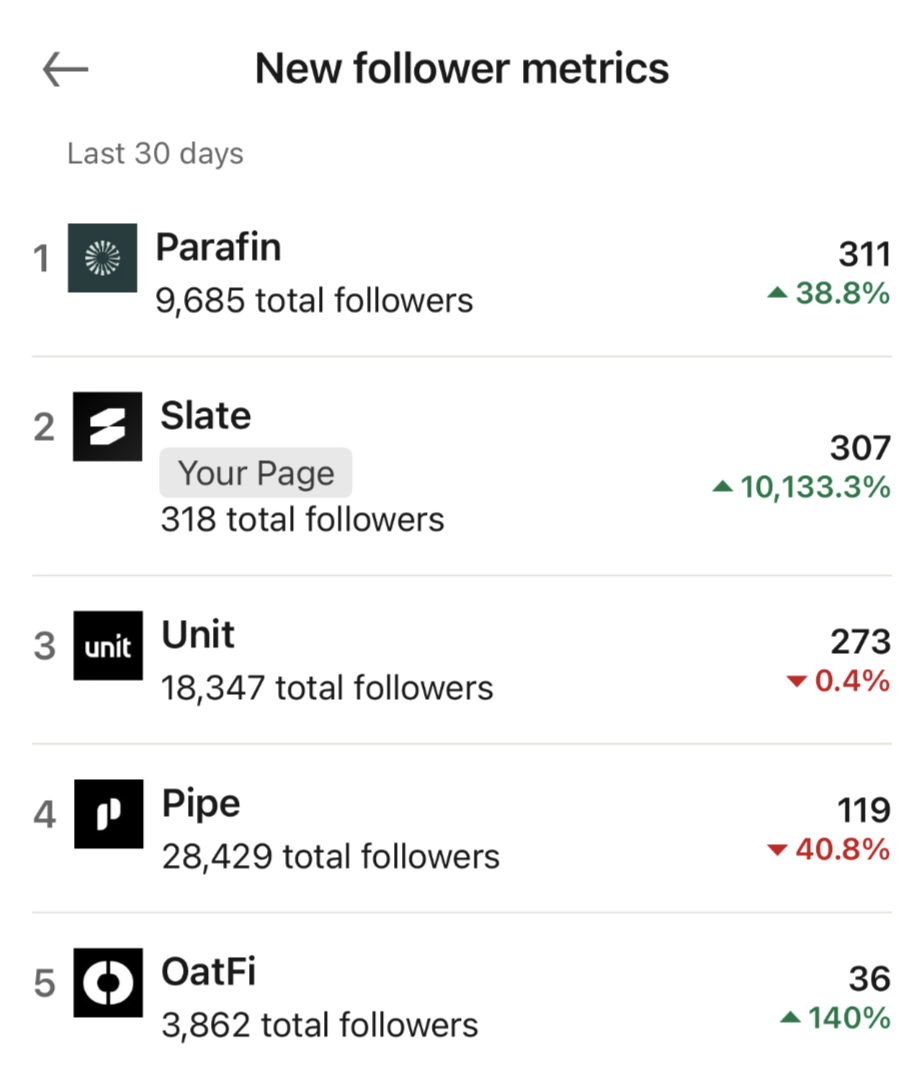
In prior roles, I've seen GTM launches optimized for awareness, growth, or press. This was the first time I've seen distribution treated end to end as a product system in the first 30 days.
The Approach
This Was a Multi-Surface Release, Not a Launch
Most launches assume a single surface. A blog post. A press hit. A company announcement.
This wasn't that.
What we ran was a multi-surface release. A coordinated deployment of the same narrative across different credibility vectors, each doing a distinct job.
The company page was not the center of gravity. It was the system of record.
Before publishing anything, we locked:
- The narrative we wanted the market to internalize
- The order in which it should be revealed
- The people and surfaces best suited to carry it
- The emotional outcome each phase needed to create
Every surface reinforced the same reality. Nothing stood alone.
We Deliberately Collapsed Time-to-Belief
Early GTM fails when belief takes too long to form.
People don't lack information. They lack confidence that a company is real, competent, and durable. Time-to-belief is the gap between first exposure and trust.
We designed the release to collapse that gap.
Each category of signal answered a different objection:
- Is this real?
- Is this serious?
- Does it actually work?
- Are there capable people behind it?
- Will this company still be here?
The goal was not reach. It was belief density.
When belief forms unevenly across stakeholders, deals stall. When belief converges quickly, deals move.
People Were the Unit of Distribution
The atomic unit of this release was not the post. It was the person.
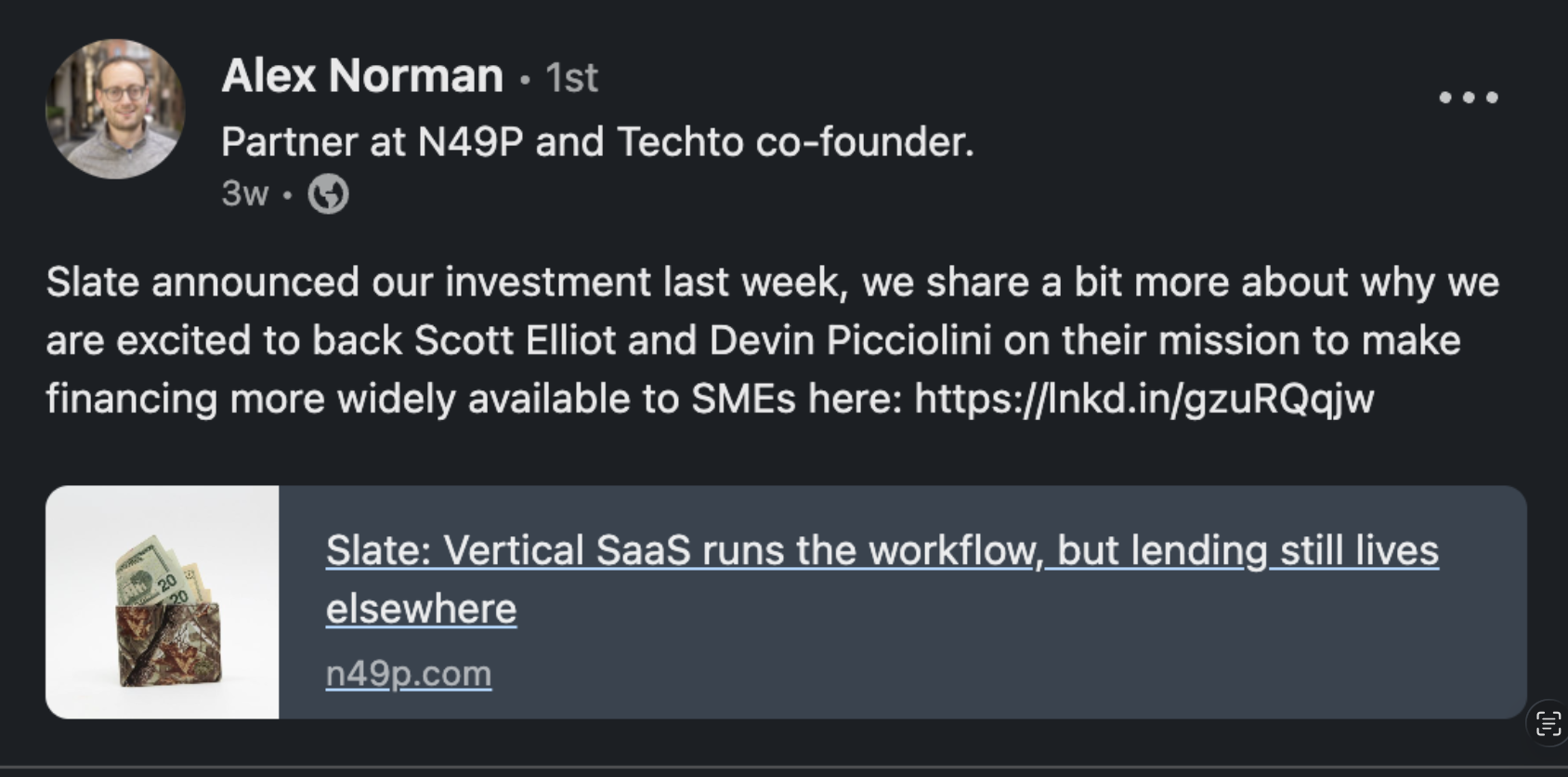
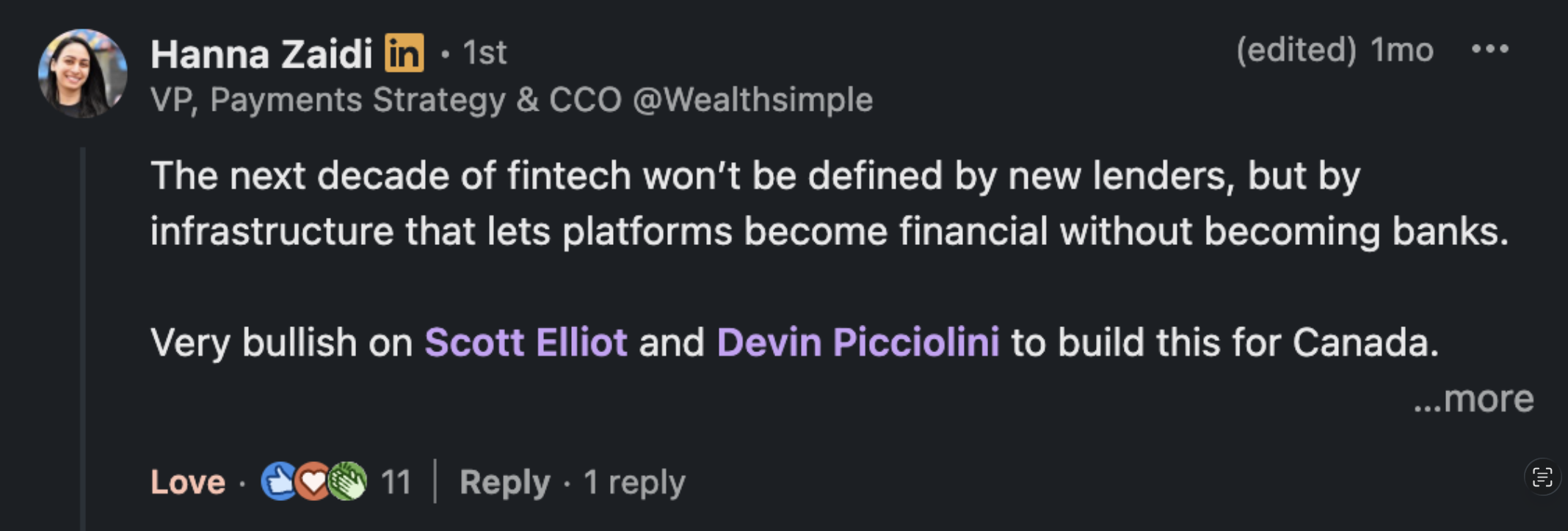
Founders, employees, investors, advisors, operators, and partners were all treated as first-class distribution surfaces. Each spoke from their own vantage point, using their own language, reinforcing the same narrative.
The company page didn't try to say everything. It curated, amplified, and legitimized what others were already saying.

Execution Mechanics
Vibe Statements as a Control System
Internally, every post, series, and week started with a vibe statement.
A vibe statement is not copy. It is not positioning. It is a constraint.
It answers one question: after someone reads this, what should they feel?
More importantly, it governs what not to say.
Vibe statements prevent accidental incoherence when many voices are involved. They keep tone stable, hype contained, and messaging aligned without scripting anyone.
This is how you scale consistency without centralizing authorship.
Narrative Sequencing
The release followed a deliberate arc. The order mattered.
Presence
Vibe: This already exists. It's real.
Founder and company posts established operational posture. No coming soon language. No speculative framing.
Proof
Vibe: This works, and it doesn't slow you down.
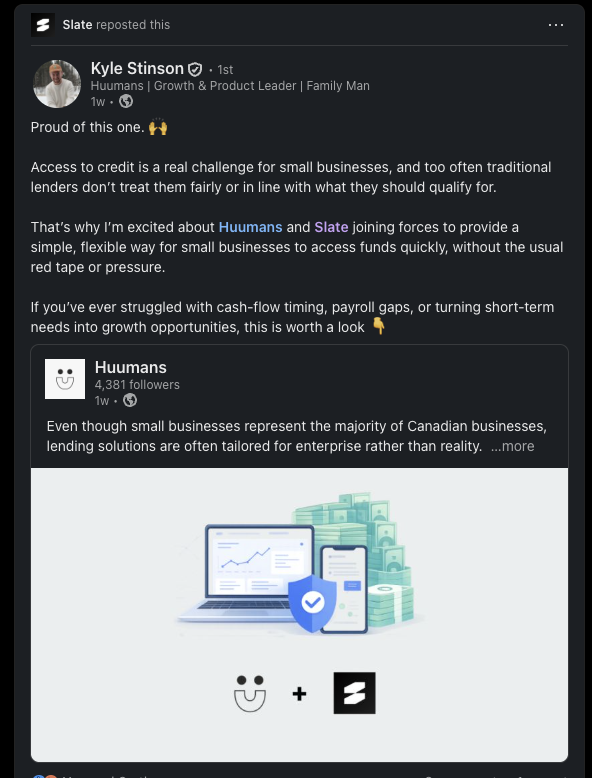
Proof came from operators responsible for shipping.
The strongest signal wasn't what Slate claimed, but what partners said unprompted: that they embedded lending quickly, compliantly, and without slowing their roadmap.
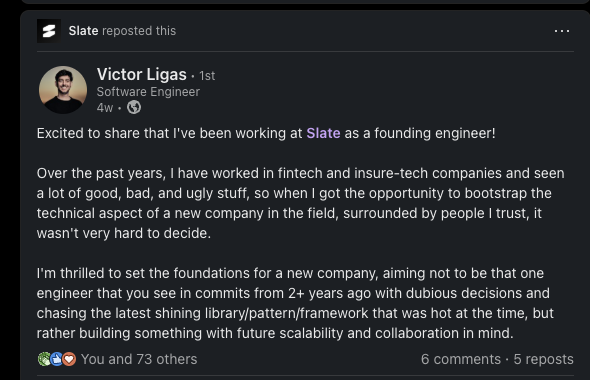
Depth
Vibe: These people understand the system.
Employee spotlights and technical framing showed judgment, taste, and experience. Not ambition. Not hype.
Inevitability
Vibe: This is happening with or without you.
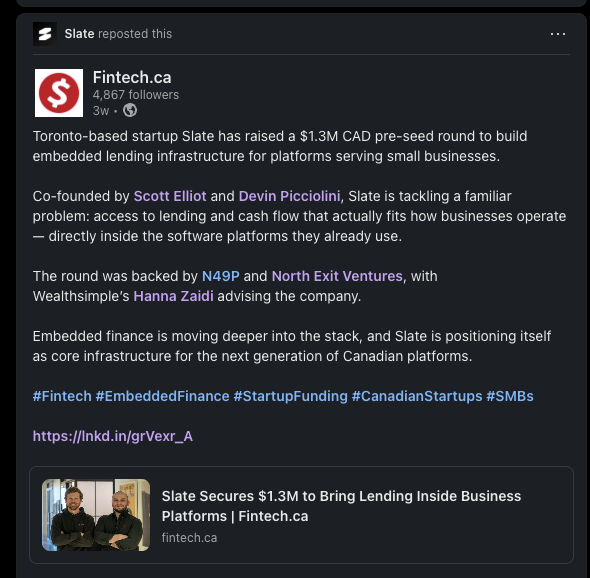
Validation stacked. Funding. Advisors. Board members. Press. Community platforms.
The market didn't need to trust Slate directly. It trusted the people willing to attach their names to it.

Human Signal as Risk Reduction
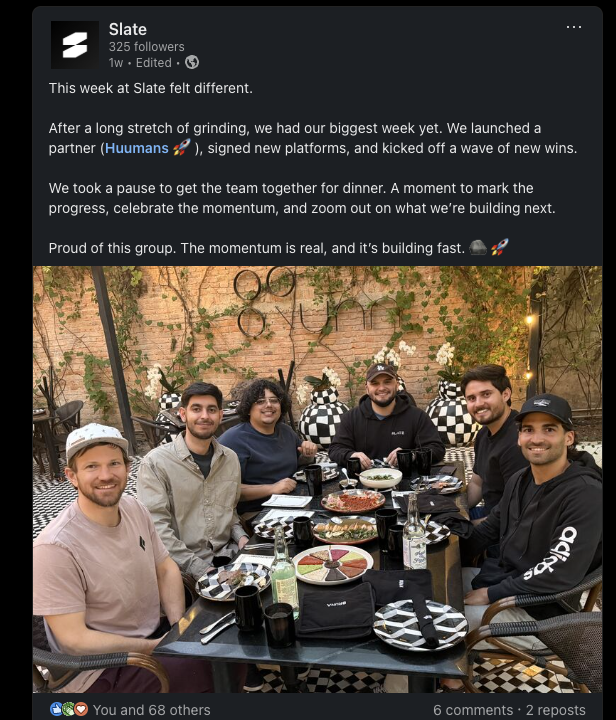
We intentionally shared moments that showed the company as it actually exists.
A real team. In the middle of real execution. Solving real problems together.
This wasn't culture theater. It was risk reduction.
In early GTM, buyers don't just evaluate products. They evaluate whether a company feels durable. Human signals reduce perceived risk in ways no metric can.
Execution Density
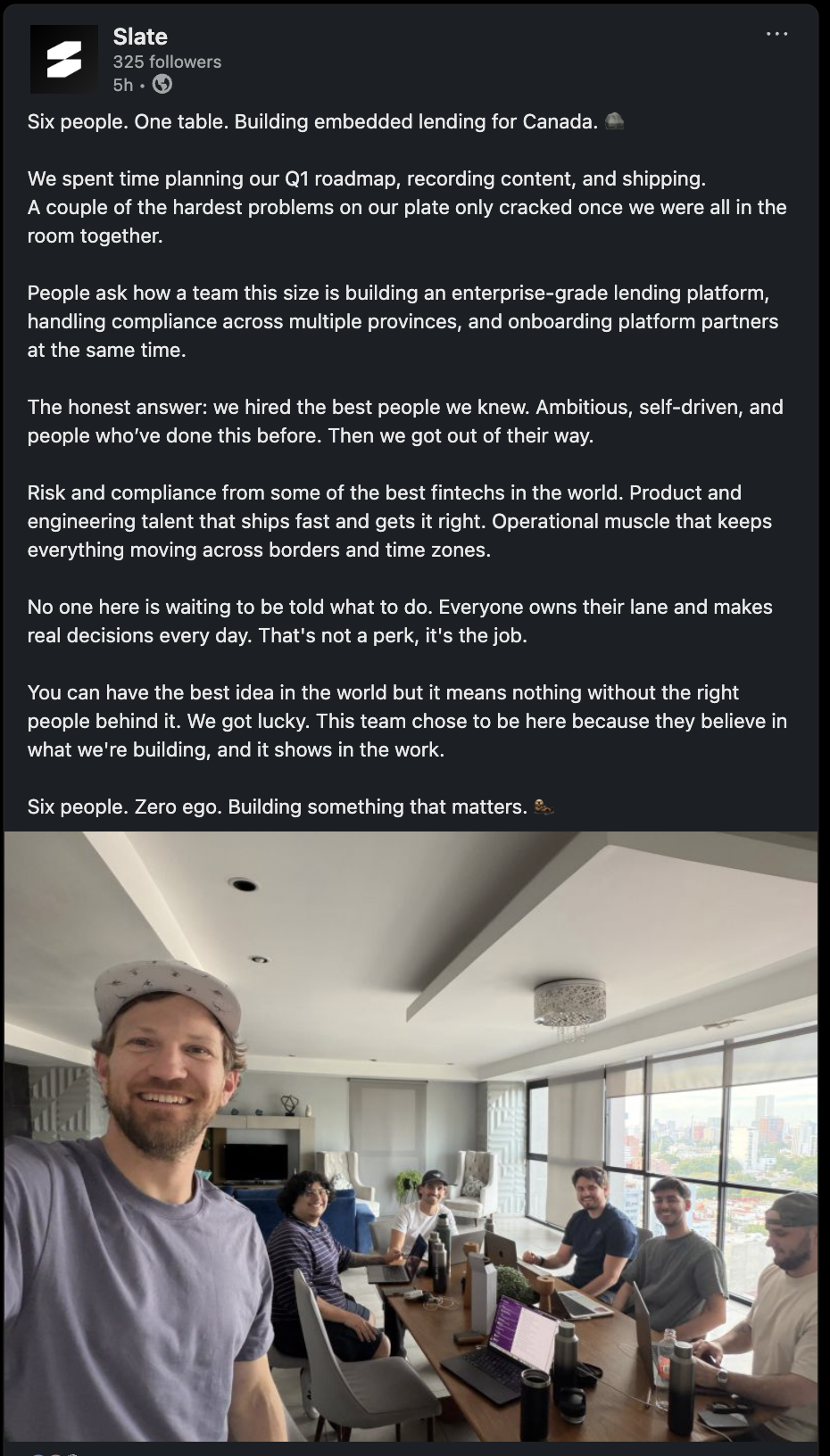
Complex systems don't get built by vibes. They get built by people making real decisions in the same room.
We showed that too.
Results
Channel Results
Over 30 days:
- 22 original posts from the Slate company page
- Supported by coordinated founder, employee, investor, partner, and press distribution
- 355 total engagements
- 307 net new followers
- +10,133% follower growth
- Highest growth velocity and engagement density among direct competitors
Business Results
In the same window:
- Multiple enterprise platforms signed
- First revenue checks collected
- Inbound demand exceeded capacity
Why This Worked
- We ran a multi-surface release, not a single-surface launch
- We deliberately collapsed time-to-belief
- We treated people as the unit of distribution
- Vibe statements prevented messaging drift
- External voices carried more weight than internal claims
- The company page acted as gravity, not volume
We intentionally avoided tactics that inflate attention without increasing confidence.
This approach can't be faked. We didn't script posts or tell people what to say. The coordination was structural, not performative. It only worked because the underlying work was real: shipping product, earning trust, solving actual problems, and building a team capable of delivering. Without that foundation, the system collapses.
Most teams post. We orchestrated.
Learnings
- Distribution is part of the product
- Belief compounds faster than reach
- Consistency beats cleverness early
- People scale trust better than brands
- Editorial restraint matters
Improvements
- Pull customer proof even earlier
- Systematize reuse of high-signal external validation
- Make vibe statements explicit in conversion moments
These are execution optimizations. The core model holds.
Takeaway
This wasn't about being loud.
It was about being legible.
One narrative. Many surfaces. Clear emotional intent. Deliberate sequencing.
That's what GTM looks like when treated as a system.